


Ahh, January. It’s that exciting time again for new year, new me. When it comes to setting up goals for your company, they can end up as fragile as your long-term gym plans. 😮💨
In the early days of SupplyPike, I’m not sure we ever had goals that lasted longer than a week. Goals would shift as quickly as the next meeting you were (or weren’t) invited to. You may (or may not) have gotten the memo, but it didn’t really matter, because no one talked about them ever again.
We learned very quickly that this was not a sustainable way to run a business. Too many resources wasted across too many teams, with too many KPIs, none of which were being tracked. If any of this sounds familiar to you, you’re in the right place.
This week, I’m sharing my 5 “dos” for goal setting with your team - these helped pave the way for us to stay more focused and get more done with less.
🔥 5 dos for goal setting in 2026

#1: Focus. Focus. Focus.
In 2020, the SupplyPike leadership team made a mental shift towards focus. We identified 2 metrics that mattered the most to us at the time
MRR: Are we making money?
GDR: Are we keeping the money we made?
Everything we did tied back to these 2 metrics. Some examples:
We identified leading metrics to warn us if we were trending off course.
Ex: Demos bookedWe redesigned our teams to optimize for those metrics.
Ex: Created a Customer Development Team dedicated to booking demosWe developed feedback loops to keep ourselves accountable.
Ex: Weekly rituals to check how many demos were booked
Having this level of clarity and transparency truly allowed us to enter our flow state.
#2: Get your team involved
Have you ever worked on goals that you didn’t believe in or didn’t understand? You probably felt unmotivated, apathetic, and lacked a sense of ownership toward those goals. Don’t let your team suffer the same consequences!
This is what we did each year at SupplyPike for roughly 50-150 people:
⬇️ Start top-down, ⬆️ then bottom-up
As a leader, you know what your team needs to accomplish for the year. If available, best practice is to involve your C-Suite and Board of Directors in these decisions. After the high level goals are established, if you have managers/team leads, this is a great opportunity for them to step up and collaborate with you and each other!
For example:
You decide “We need to hit $1M in ARR this year.”
Your customer development lead might say “To hit $1M in ARR this year, we will need to complete 100 demos.”
Hearing this, your marketing lead might say “To complete 100 demos, we will need to bring in 1,000 website leads.”
💡 Note: If your team is at the beginning of your journey and you do not have historical performance yet, use industry benchmarks to start. It’s still important to make sure your team understands why you chose those numbers.
🎙️ Bring the Team In
Discuss the goals you’ve drafted at your next company-wide meeting. Ask for their feedback and - now this is really important - actually mean it. These are the numbers the entire company will be working towards for the next 12 months, so it’s worth spending a good chunk of time on this.
Pro-Tip: Share a copy of your draft via Slack/Teams for folks to provide more feedback after the meeting. Some folks might need more time to reflect; others might be better writing their thoughts down. Giving your team multiple avenues to provide feedback signals that you actually want it.
It’s up to you to weed out what suggestions do and don’t make sense, but you want your team to feel heard and, more importantly, to understand why the goals are what they are. The intent is to leave them feeling energized and motivated for the next 12 months!
#3: Communicate back WTF we’re actually doing here
This step sounds obvious but you’d be surprised at how often it gets forgotten. Once the goals were solidified, we found it helpful at SupplyPike to have them printed and posted around the office. Having your goals on a piece of paper really signals finality and stability to your team so they can start running.
Here’s what we did:
Fit your goals in an easy-to-digest 1-pager
Yes, ONE page. We are creating a cheat sheet for our team to refer back to frequently so this one pager should be easy to read, digest, and understand. Bonus points if it’s also nice to look at (get your designers involved! 🎨).
PS: If you’re having trouble fitting it all on one slide, that may be a sign that you need to go back to the drawing board to find some focus.
Print and post them around the office
We typically printed 3x5 ft posters and hung them up in multiple places across the office where employees could see them even from their desks. I have genuinely seen employees walk up to our posters mid-discussion to reference the “official” words on paper. Words matter.
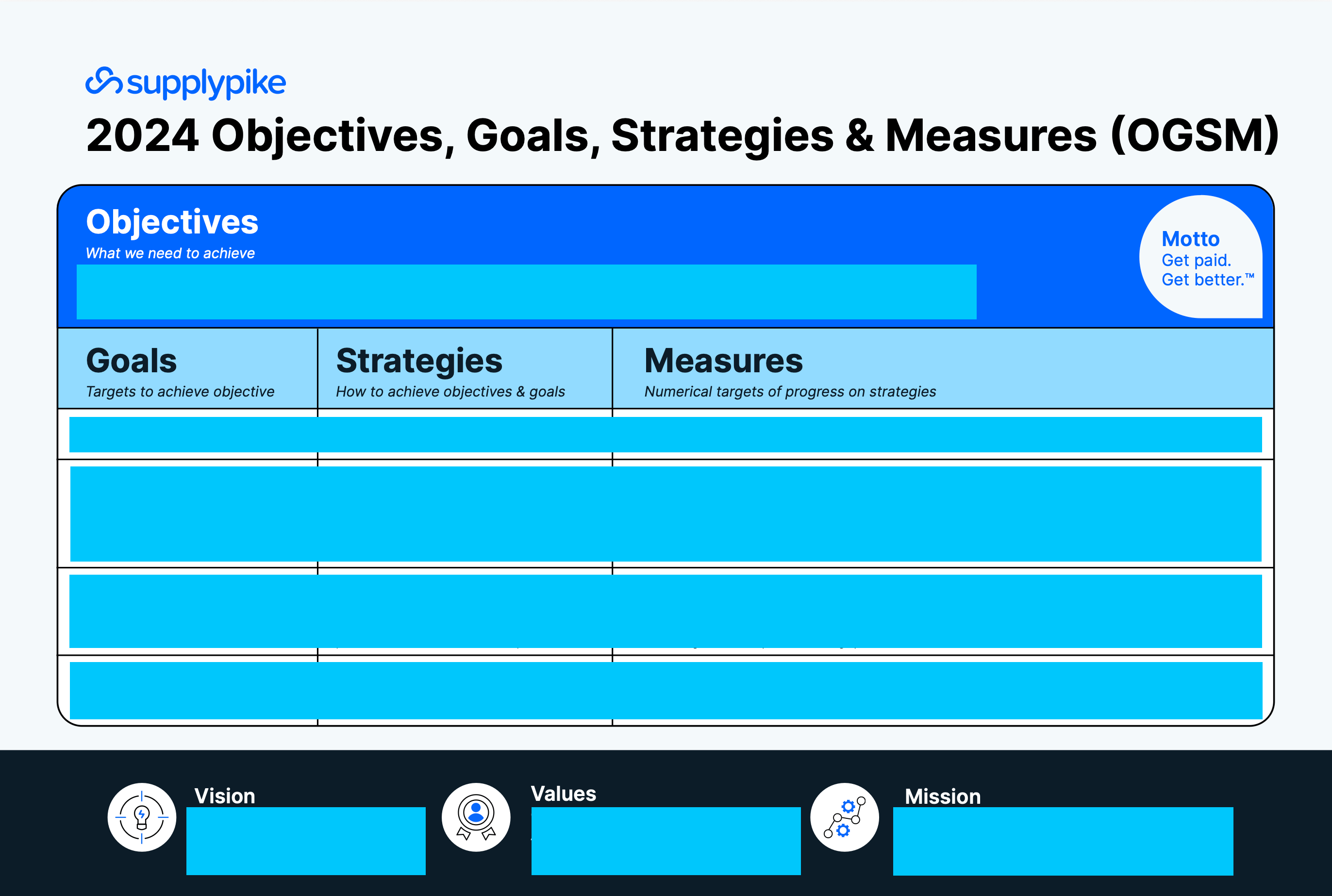
Here is a real-life (redacted) poster that we hung on the walls. We used the OGSM framework to set up our goals, but you can use whichever framework speaks to you!
#4: Circling back in the new year
Okay, you’ve channeled focus, collaborated on goals, and communicated the finalized decisions with the company.
Phew! Pat yourself on the back, that was a lot of work and we don’t all that work to go to waste. Unfortunately, it can be really easy to lose sight of the actual goals we set as business needs shift and “shiny” new work appears.
Here are some ways we combatted this:
Keep your 1-pager as your anchor. Always refer back to this.
Create systems and rituals to continually check back on your goals. We had rituals that were weekly, monthly, quarterly, and annually that allowed us to both zoom in and out of the goals and measure performance.
Have open and honest communications with your teams to see how they are performing and feeling about the goals. Allow for some level of flexibility and pivot resources to channels that are working.
📚 Thinking in Systems by Donella H. Meadows is a great book that our leadership team read together that discusses some of these topics.
#5: Bend, but don’t break
Now, let’s fast forward and say you’re 6 months into the year and you realize the goals you thought of might not make sense anymore. Hey, it happens.
Have open, honest, and transparent conversations with your leaders to decide if you should stay the course or course correct. Here are some questions you can ask yourself to decide your next step:
Did we put all of our best efforts into achieving this goal or was there an internal performance issue? Are there any incremental changes that could work?
Is this level of performance typical against the industry benchmark? Is there another channel/activity that is performing well and worth putting more fuel into?
Is there something else happening in the world that affects our industry? COVID-19 and tariffs are great examples of events that caused major implications to all businesses.
If your team decides to course correct, that’s okay! Re-read the first 4 sections above to make sure you’re continuing to focus, get buy-in, actively communicate, and measure success.
Thank you for taking the time to read this post! Please leave a comment with either a “do” that has helped you when goal setting or a personal goal you have for 2026! 🔥
Have a wonderful week!
Christine
Christine’s Corner
📖 Read of the Week: I’m still making my way through Iron Flame by Rebecca Yarros. It’s a long book y’all.
🍿 Watch of the Week: I rewatched Pokémon the Movie 2000 for the first time in 20 years because my nephew is obsessed with Pokémon…and that movie still slaps.
🎧 Song of the Week: I’m a late fan, but I’ve been listening to Olivia Dean lately! Let Alone The One You Love is so good!